Standard monthly reporting (Layer 3 alignment)
Every DCA should report in a standard monthly pack so performance and conduct are comparable. Your organisation may define the authoritative specification in internal policy (for example Layer 3 of a DCA governance framework).
Why it matters: contingent economics only work when numerators and denominators match between placement, collections, and fee lines. The monthly pack is where first line, risk, and finance usually see the same story.
Source of truth for Layer 3. Layer 3 reporting should be derived from CP-controlled data and reconciled views. DCA-reported data supports operations, vendor challenge, and dual-state checks, but it does not replace CP truth for authoritative balance, placement state, or financial outcomes. See Source of Record and Reporting data lineage.
Controls framework. Layer 3 must be supported by the controls framework: definitions, reconciliations, recall execution evidence, and ownership of exceptions. Governance reviews the pack; controls produce defensible numbers. See Controls framework.
Reporting must be rooted in CP authoritative data. DCA-reported metrics are supporting inputs and challenge data only for financial and regulatory narrative unless your policy explicitly defines a narrow exception with audit trail.
Credit reporting. Status changes shown to credit bureaus must align with CP operational truth for balance, closure, and settlement outcomes. DCA platforms must not drive bureau submissions unless explicitly authorised; misalignment between collection activity and bureau state is a common complaint and conduct theme.
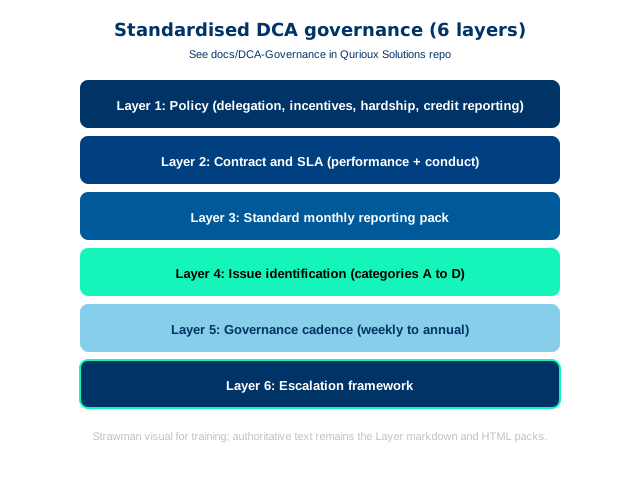
Why Layer 3 matters in the stack
Policy sets appetite; contract sets minimums; Layer 3 is where evidence accumulates that the programme behaves as designed. Without a stable monthly pack, issues management becomes anecdotal, finance cannot tie cash to cohorts, and risk cannot sample fairly. Layer 3 is not “reporting for reporting”; it is the observability layer for a contingent model.
Who uses the pack
| Audience | Typical use |
|---|---|
| First line collections or recoveries | Run-state decisions, vendor challenge, operational fixes |
| Finance | Fee accruals, recoveries recognition narrative, period close questions |
| Risk and compliance | Conduct trends, SLA breaches, attestation and issues |
| Internal audit | Traceability from placement file to GL attribution |
| Vendor governance | Scorecards, remediation plans, contract evidence |
Standard monthly pack: mandatory sections (Layer 3)
Every DCA must use this identical format so packs are comparable and can be consolidated for risk committee and attestations. Unless Layer 1 policy approves an exception, no DCA should submit a different layout. Below mirrors STD-DCA-REPORT-001 (Qurioux DCA Governance Layer 3). Complete all fields; use “N/A” only where the template explicitly allows.
Section 1: Portfolio snapshot
| Field | Description | Format / unit |
|---|---|---|
| Reporting month | Month and year | YYYY-MM |
| DCA name | Legal entity name | Text |
| Accounts assigned (opening) | Accounts on DCA at start of month | Count |
| Accounts assigned (new) | New assignments during month | Count |
| Accounts closed | Closed during month (split by closure reason) | Count |
| Accounts assigned (closing) | Accounts on DCA at end of month | Count |
| $ exposure (opening) | Total $ balance at start of month | Currency |
| $ exposure (closing) | Total $ balance at end of month | Currency |
| Age at assignment (new) | Distribution: 0–30, 31–60, 61–90, 90+ DPD | Count per bucket |
| Segment mix (new) | Product or segment breakdown of new assignments | Count per segment |
Closure reasons typically include: Paid in full, Settled, Hardship (referred or closed), Legal (referred), Write-off (bank decision), Returned to bank, Other (specify).
Section 2: Performance
| Metric | Definition | Notes |
|---|---|---|
| $ collected | Total $ received during month (cash received) | Compare prior month in template |
| $ assigned (month) | $ balance of accounts assigned in month (recovery rate denominator driver) | Cohort rule fixed in contract |
| Recovery rate | $ collected / $ assigned (per agreed cohort, e.g. assigned in month or on book) | Target may be by segment |
| Cure rate | % of assigned accounts that cured (per bank definition) | By segment if required |
| PTP keep rate | % of promise-to-pay commitments honoured in period | Example target e.g. ≥ 70% |
| Time to first contact | % of new assignments with first contact within 5 business days | Example target e.g. ≥ 95% |
| Non-treatment > 14 days | Count and % of accounts with no treatment > 14 days | Example tolerance e.g. < 5% |
Additional rows may be required for segment breakdown where the contract says so.
Section 3: Conduct
| Metric | Description | Expectation |
|---|---|---|
| Complaints (internal) | Complaints received by DCA from customers (about collection conduct) | Prior month compare |
| Complaints (FSL / external) | Complaints referred to Financial Services Lens or other external body | As applicable in your market |
| Complaints per 1,000 accounts | (Complaints / accounts on book) × 1,000 | Rate tracking |
| Hardship referrals | Count of hardship referrals to bank in month | As required |
| Hardship referral timing | % of referrals within 1 business day of identification | Per protocol |
| Contact compliance | % of accounts where contact frequency and hours were within policy | Often 100% expected |
| QA pass rate | % of sampled calls or letters passing QA criteria | Example e.g. ≥ 85% |
| Disclosure compliance | No collection before disclosure where applicable | 0 breaches; Pass or Fail plus count |
Any conduct breach (disclosure, contact, complaint upheld) should appear in a breach register with date, account, description, and remediation.
Section 4: Delegated authority
| Metric | Description | Threshold / note |
|---|---|---|
| Settlement volume (count) | Number of settlements executed in month | Per schedule |
| Settlement volume ($) | Total $ settled in month | Per schedule |
| Settlements by threshold | Count in each band (e.g. ≤70%, 71–80%, >80% with approval) | Per Delegated Authority Schedule |
| Waivers approved (DCA within limit) | Count and $ within delegated limit | Per Schedule |
| Waivers above limit (bank approved) | Count and $ above limit with bank approval reference | List refs |
| Overrides | Count of bank-approved overrides to normal delegation | List references |
| Unauthorised settlement or waiver | Any settlement or waiver outside authority | Must be 0; if > 0 treat as Category B issue per Issue taxonomy |
Section 5: Risk indicators
| Indicator | Description | Typical expectation | Status |
|---|---|---|---|
| Non-treatment > X days | Accounts with no treatment > X days (e.g. 14 or 21) | e.g. < 5% | R / A / G |
| Accounts > 90 DPD still early stage | Potential delay in escalation path | Monitor; escalate if trend | R / A / G |
| Legal timing breaches | Referrals to legal outside agreed timing or process | 0 | R / A / G |
| Disclosure breaches | Any breach of applicable disclosure law or policy (e.g. s 132A NCCP in Australia, where relevant) | 0 | R / A / G |
| Attestation status | Current attestation submitted and signed | Y | Y / N |
| Open issues (Layer 4) | Count of open issues by Category A / B / C / D | Track | Track |
R / A / G = Red, Amber, Green per the bank scorecard.
Section 6: Spin down report (vintage by referral month)
The spin down report is a cohort style recoveries view by referral month (vintage). It is not an offboarding report. Columns are usually referral month buckets: M1, M2, M3, … M12, M12+ where M1 is the most recent referral month, M2 the prior month, and M12+ all debt referred more than 12 months ago. Values are as at the report date (e.g. month end).
Typical row metrics: $ referred at assignment for that cohort; $ collected (cumulative to date for that cohort); # accounts closed; # recalled (returned to bank); # cured; # still on book (open). The bank may add rows (e.g. # settled). Same format for every DCA enables comparison of recovery roll rates by vintage. Template and sample may live in the organisation’s monthly pack workbook or dashboard alongside the governance repository.
File format, delivery, and audit
- Format: Excel, CSV, or bank-specified template (see
docs/DCA-Governancefor samples). - Delivery: Secure portal or email to the address in contract.
- Naming: e.g.
DCA_MonthlyPack_[DCA_Name]_[YYYY-MM].xlsxor as agreed. - Version: State reporting pack specification version in the file (e.g. “Std Report v1.0”).
Data in the pack must be consistent with the DCA’s operational records and with files supplied for placement and closure. The bank may audit against the pack; material variance is typically a serious issue (e.g. Category C) and may affect attestation and scorecards. The specification is reviewed when SLAs or risk indicators change.
One definition of recovery rate
Recovery rate disputes destroy trust. Pick one numerator and denominator, publish it, and ensure the DCA’s internal dashboards either match or explain variance as a reconciliation item, not a competing truth. Common anti-pattern: DCA shows higher recovery rate by using a smaller denominator or by counting gross inflows before refunds.
Mapping: sections to audience questions
| Pack section (typical) | Example question |
|---|---|
| Portfolio snapshot | What moved in and out of the DCA this month? |
| Performance | Are we collecting to plan? Is recovery rate on definition? |
| Conduct | Are complaints and hardship within appetite? |
| Delegated authority | Any settlement band breaches? |
| Risk indicators | What is red and who owns the fix? |
| Spin down (vintage) | How do older cohorts behave? |
Why this matters for contingent economics
Fees should reconcile to gross collections attributed to the DCA, refunds and reversals, and fee tiers in the contract. Mismatch between placement files, collections ledger, and monthly pack is a common audit theme. Design reconciliations early.