Written-off debt: MoSCoW and journey
Summary. Start with the master recoveries flow (decision point, contingent vs internal vs debt sale). This module focuses on written-off accounts that follow the contingent debt path: twelve themes in MoSCoW, then a detailed journey from write-off through R1, monitoring, recall, optional R2, and exit. Your credit provider (CP) stays system of record.
Scope note. DCA placement does not require a write-off in principle. This module is narrow by design: many banks still route most contingent DCA volume to written-off or charge-off segments, so the pack invests here. Your programme may also use DCAs pre-charge-off.
Why volume concentrates here. Post write-off populations are often large, relatively homogeneous in the sense of “already impaired,” and politically easier to industrialise through panels than to staff internally to the same scale. That does not make the work simple: it raises the stakes for conduct, data quality, and traceability because customers may already be in stress.
MoSCoW prioritisation
M = Must have · S = Should have · C = Could have · W = Won’t in this phase (explicit non-goal)
| # | Theme | MoSCoW | Rationale (short) |
|---|---|---|---|
| 1 | Eligibility and entry criteria | M | Unsafe to place without clear write-off, recoverability, exclusions. |
| 2 | Segmentation and allocation strategy | S | Fair routing; can start simple then deepen. |
| 3 | Decision ownership and governance | M | Placement, recall, contingent vs sale vs internal need accountability. |
| 4 | Placement process | M | Standard steps, data pack, cadence. |
| 5 | Customer communication | M | Regulatory and conduct minimums; notifications and suppression. |
| 6 | Monitoring and performance | M | Thresholds tie to SLA and monthly pack. |
| 7 | Recall and reassignment | M | Compliance and strategic recalls; R1 and R2 linkage. |
| 8 | Payment handling and reconciliation | M | CP as SoT; daily sync and integrity. |
| 9 | Shortfall and end-state handling | S | Elevate to Must when sale, waive, or abandon rules are in scope. |
| 10 | Compliance and conduct | M | Maps to governance and codes. |
| 11 | Data and reporting | M | Monthly pack and R1/R2 traceability. |
| 12 | Gap closure (policy, benchmarking, recall governance) | S | Treat as Must for audit-ready programmes. |
MoSCoW summary
- Must: themes 1, 3, 4, 5, 6, 7, 8, 10, 11.
- Should: themes 2, 9, 12.
- Could: extended champion/challenger, R3+ on an event model, rich override analytics.
- Won’t (typical v1): DCA as balance SoT; silent recalls; weekly-only payment updates on active placements.
Journey (contingent path after write-off)
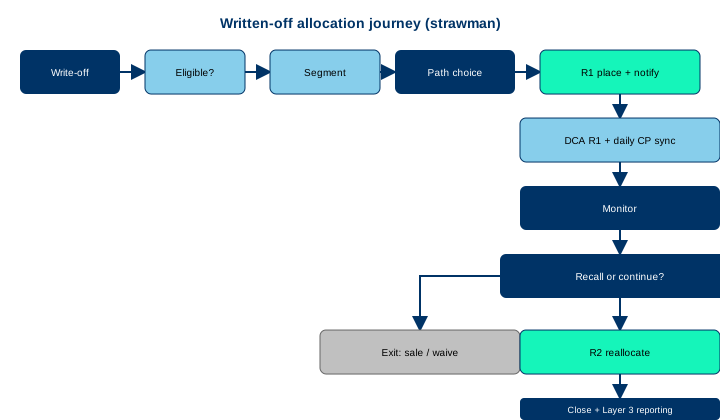
This is a zoom-in on the contingent debt column from the recoveries decision diagram, after accounting write-off.
Journey notes
R1 and R2 are operating model constructs, not mere labels. They imply different commercial terms, trace fields, cohort reporting, and often different playbooks. R2 is not “same again.” If your R2 hypothesis is identical to R1, you are usually buying duplicate contact without learning.
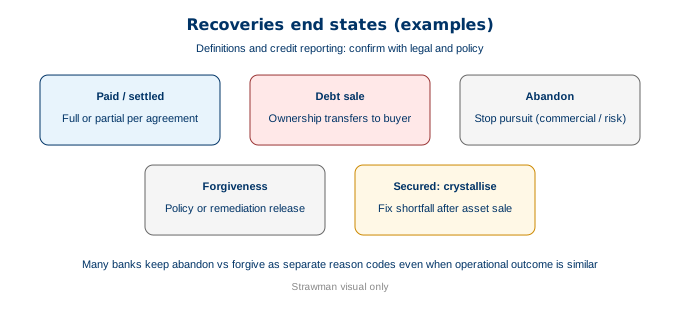
End states require governance because the DCA cannot decide to forgive debt, sell the bank’s asset, or abandon pursuit on behalf of the CP without explicit authority. Silent closure in a vendor system without CP recall is a recurring audit and conduct failure mode.
- CP stays authoritative for balance and payments; DCA-reported state reconciles to CP (dual-state model).
- Recall may be immediate (hardship, complaint) or strategic (non-payment, reallocation).
- R2 is not a repeat of R1: different strategy, coded recall reason, optional cooling-off.
- Exit to debt sale or waiver is a governed decision, not a silent DCA closure.
Allocation economics and policy overlays sit in Allocation strategy and decisioning. End-state definitions sit in End states and closure decisions.
End states (examples)
Deep dive: Source of Record (SoR, GL, post write-off) · CP / DCA files and SoT · Back to pack home