Source of Record (SoR), write-off, charge-off, and post write-off debt management
Purpose. Explain where the truth of balance and status lives before and after accounting write-off, how that relates to the general ledger (GL) and recoveries operations, and why reconciliation and CP ownership matter when a DCA is in the flow. This page is conceptual. For file feeds, dual-state fields, and R1 or R2 mechanics, continue to CP / DCA files and SoT.
Terminology. Source of Record (SoR) names the control question: which system do you trust for this purpose? Interface specs often say system of record (SoT) for the same bank-owned authoritative ledger. They are not different truths: the credit provider (CP) remains accountable for balance, payments, conduct, and regulatory reporting. Implementation is often a recoveries or collections subledger plus GL, not the DCA spreadsheet.
Controls, recall, and COF in this pack. SoR ownership is a control domain, not only a data definition. The practical control framework for DCA and recoveries is in Controls framework. Recall is a major control and state transition; see Recall and reassignment and technical file design in CP / DCA files. Where your bank uses a Control Orchestration Framework to engineer obligations into execution, start with COF for DCA and Controls to COF mapping in the technical blueprint.
Key illustrations

Definitions (quick reference)
| Term | Meaning in this pack |
|---|---|
| Source of Record (SoR) | Which system you trust for a given purpose (balance, status, history). |
| System of record (SoT) | Often the same bank-owned truth as SoR in specs; CP accountable. |
| Charge-off | Classification or trigger (non-performing, routing). Often aligns with write-off in time. |
| Write-off | Accounting entry: reduce loan asset, recognise loss (simplified). |
| General Ledger (GL) | Financial aggregates: impairment, recoveries in period, P&L. |
| Recoveries (CP) | Operational book: account balance, placement, recall, DCA reconciliation. |
1. Why this matters
Many issues in recoveries, DCA management, reconciliation, and customer complaints trace back to one gap: no one is clear where the truth of the balance sits after write-off.
People often assume one of the following is enough on its own:
- The core banking system still holds the full operational balance.
- The general ledger holds enough detail to run collections.
- The DCA platform can be treated as the balance of record.
In practice, none of those assumptions is sufficient by itself. You need a clear view of which system answers which question, and how they reconcile.
2. What we mean by Source of Record
SoR is a control concept, not a vendor product name. It means: if you need the balance, status, or history of this debt, which system do you trust for that purpose?
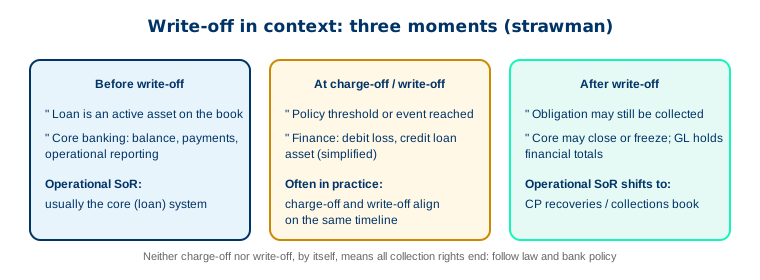
Pre write-off, the core banking (or loan) system is usually the operational SoR for the live loan: it holds the balance, processes payments, and drives much of operational reporting.
Post write-off, the picture gets more complicated. The loan may be closed or frozen in core while recoveries still needs an account-level view for placement, contact, and regulatory questions. That is why a credit provider (CP) owned recoveries or collections book is usually in play (see below).
3. What actually happens at write-off
The simple view (often wrong)
Default → write-off → debt is gone.
The real view
The bank concludes the loan is unlikely to be recovered for accounting purposes, takes an accounting loss, and the obligation can still exist for collections and customer treatment. Collections activity often continues.
Write-off is first an accounting outcome. What happens next depends on law, policy, and product.
4. Charge-off vs write-off
Textbook: charge-off is a classification or trigger; write-off is the accounting entry that removes or reduces the asset and recognises loss.
In practice, many banks combine charge-off and write-off on the same timeline and use the terms interchangeably in conversation because systems align policy triggers and finance posting, and operations do not split the two.
Typical flow: threshold (for example 180 DPD unsecured, or a secured recovery trigger) → non-performing classification → finance posts debit to loss, credit to loan asset (simplified). Teams may say it was written off and charged off in one step.
Why the distinction still matters: charge-off drives stage, reporting, and routing; write-off is the balance sheet consequence. Neither term, by itself, means the debt is gone for all purposes. Forgiveness, sale, statute, or settlement are separate ideas.
Regional language (orientation only): many US materials foreground charge-off and DPD thresholds. Australia and New Zealand packs often use write-off and impairment language in finance papers. Fix definitions in your policy and chart of accounts. This page is not accounting or legal advice.
5. What happens to the account after write-off
Core behaviour (common): after write-off, many cores close or retire the loan, freeze the balance for normal transaction processing, or stop treating the account as actively accruing the same way. The loan asset is no longer active in the originating sense.
Recoveries perspective: the customer may still owe; payments may still occur; collections must continue.
The gap: the system that held the performing loan is often not the right place to run post write-off work at scale. Banks use recoveries books, subledgers, or case platforms under CP control.
6. Role of the General Ledger (GL)
The GL tracks totals for write-offs, recoveries, impairment movements, portfolio and period P&L, and often a recoveries line that aggregates recovered cash.
The GL does not replace account-level servicing for “what does this customer owe right now?” in operational terms.
Example: customer owed $10,000 and pays $2,000. The GL records $2,000 recovery in the period (simplified). GL alone does not replace a per-customer remaining balance view: that lives in CP-controlled operational systems.
7. The shift in Source of Record (two questions, not two owners)
After write-off, separate questions:
- Financial truth (GL and finance subledgers): totals, impairment, period recovery, P&L.
- Operational truth (recoveries under CP): account-level balance, payments, stage, holds, placement, recall, customer activity.
Critical principle: the credit provider remains accountable for reporting and conduct. The operational place you query for recoveries is typically a CP-owned recoveries or collections system of record, not the DCA platform.
8. Why a recoveries-capable system must hold operational truth
Someone must answer per account: what does the customer owe now, what have they paid, what remains, what stage or placement applies? The GL cannot answer at customer level. The original core may be frozen or closed for that product. The bank implements operational SoR in a recoveries stack it controls.
Example: written off at $10,000; customer pays $2,000 via DCA. The recoveries (CP) view should show payments $2,000 and remaining $8,000 (subject to fees, post-WO interest rules, policy). At the same time, GL shows $2,000 recovery in the period for finance. Both can be correct. They answer different questions.
9. Interaction with the DCA model
Flow (simplified): accounting write-off → operational balance and placement in CP recoveries → send to DCA (R1) per policy → DCA collects and reports → CP updates authoritative balance and posts to finance per rules.
Critical control: the credit provider remains the Source of Record for balance and outcomes that drive conduct and regulatory position. The DCA provides reported activity and balances for reconciliation, not silent override of CP truth. Dual-state design: CP / DCA files.
10. Why reconciliation becomes critical
You have DCA-reported balance and status, CP recoveries authoritative view, and GL or finance aggregates. If these drift, customers can be over-contacted or worked on stale amounts; payments can lag; audit trails weaken.
Typical cadence: daily payments, status, recall, balance alignment; weekly trends in breaks and delays; monthly full alignment for governance and attestation.
Control checks (examples)
| Check | Question it answers |
|---|---|
| Payment bridge | Do cash collections posted in the period in GL match CP recoveries allocation for the same scope (allowing cutoffs)? |
| Scope | Are DCA placements, recalls, and internal payments in one authoritative population? |
| Dual-state | On active placements, does CP balance reconcile to DCA-reported balance within tolerance after each feed? |
11. Common failure patterns
- No clear SoR post write-off (spreadsheets, partial exports) → inconsistent balances and disputes.
- GL treated as account truth for contact decisions → no stable per-customer view.
- DCA becomes de facto SoR → conduct and governance risk.
- Weak reconciliation → errors compound.
12. End of lifecycle
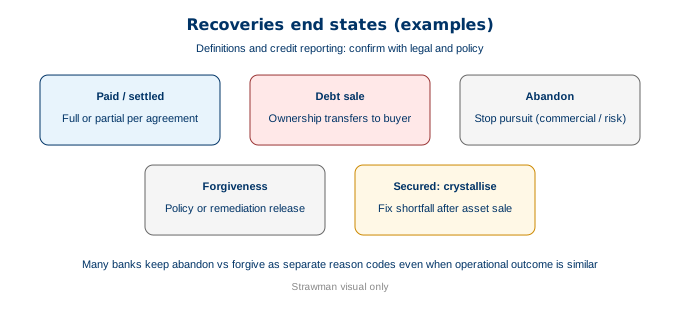
Terminal states depend on your policy and law: paid or settled, debt sold, abandoned, forgiven.
Abandon versus forgiveness
Many programmes use both as terminal paths: no further internal work, no DCA placement, no legal escalation under that policy. The customer-facing outcome can look similar (for example both move to closed or inactive treatment). The usual difference is why you stopped, usually captured in the reason code, not only the label shown to the customer.
| Attribute | Abandon (typical driver) | Forgiveness (typical driver) |
|---|---|---|
| Outcome | Stop pursuit | Stop pursuit |
| Reason | Commercial: not economical, risk, governance | Policy: remediation, hardship, delegated relief |
| Governance | Often collections or strategy thresholds | Often higher authority and conduct trail |
| Credit reporting | Confirm with policy | Confirm with policy |
Typical listing may be settled or not paid in full where applicable. Legal and compliance own wording.
Recommended data: store End_State_Type (Abandon, Forgive, and so on) and End_State_Reason (coded) so commercial exits are reportable separately from conduct-driven exits.
Waiver
Waiver may mean stop pursuing or waive part of the balance under delegated authority. Legal meaning varies: your legal team defines whether waiver extinguishes debt or only ends collection activity.
Crystallise (secured)
Crystallised shortfall usually means the unsecured residual is fixed after asset realisation. That amount then flows into unsecured recoveries, DCA, sale, or waive or abandon. It is a quantification step, not the same label as forgiveness or abandon.
13. Bringing it together
| Phase | Operational SoR (typical) | GL |
|---|---|---|
| Pre write-off | Core (loan) system for live loan | Aggregates financial outcomes |
| Post write-off | CP-owned recoveries or collections book (subledger or case platform) for account truth | Financial truth: totals, impairment, recoveries in period |
CP is accountable for coherent design across core, recoveries, GL mapping, and DCA feeds.
14. Final takeaway
Write-off removes or reclassifies the loan asset for accounting. It does not, by itself, end all operational or legal meaning of the debt. If you do not define where the operational balance lives after write-off, placement, recall, customer treatment, and reporting break.
Bottom line
- Clear SoR ownership (CP-led operational system, not the DCA).
- Clean separation of GL totals vs account-level recoveries truth.
- Strong reconciliation between CP, DCA-reported state, and finance.
- Governance over DCA data as inputs, not silent authority.
This is the foundation for recoveries, DCA management, and oversight.
Questions to resolve before sign-off
- Where is the account-level balance stored and updated after write-off?
- Who owns payment posting from internal channels and from DCA feeds?
- How often do you reconcile CP recoveries to GL recovery lines, and who owns breaks?
- Can you explain a customer balance at any time from CP systems, not the DCA portal alone?
- Are end states coded with reason so commercial and conduct exits report separately?
Layer 3 reporting and Source of Record
Monthly governance reporting should be built from CP-controlled balances and cohort definitions, with DCA-reported fields used for challenge and dual-state checks. If Layer 3 is assembled only from vendor PDFs, you lose the link between operational SoR and finance truth, and recovery rates become arguments instead of measurements. See Reporting and Reporting data lineage.
Related topics
- CP / DCA files and SoT (feeds, dual-state, reconciliation)
- Written-off allocation (MoSCoW, R1, R2 journey)
- Recoveries decision (master treatment paths)
- Glossary (SoT, SoR, R1, R2)