What is a DCA and what is contingent collection?
Purpose
Give stakeholders a shared vocabulary before you design requirements, reporting, and governance for debt collection agency (DCA) engagements.
Do not confuse DCA with “written-off only.” Debt can be outsourced to a DCA without an accounting write-off: the creditor still owns the receivable. In practice, many banks place most contingent DCA volume after charge-off or on written-off books, so this pack also goes deep on written-off allocation. That emphasis reflects common volume, not a rule that DCA only applies after write-off.
COF (orientation). This pack includes a technical blueprint chapter on the Control Orchestration Framework (COF) as applied to DCA and recoveries. It is not the full enterprise COF manual; it explains how engineered execution complements policy and manual controls. See COF for DCA when you are ready for blueprint depth.
Basics: BPO, DCA, and DLP
Three commercial models compared side by side.
| Model | Owner of debt | Represents as | Collection stages | Commercials | Final result (illustrative) |
|---|---|---|---|---|---|
| BPO | Creditor or lender | Creditor or lender (BPO runs the creditor’s process) | Any stage | Pay per service or FTE | Scalable, cost-effective capacity |
| DCA | Creditor or lender | The DCA (third party) | Recoveries / contingent collections | Commission on recoveries | Variable cost tied to cash collected |
| DLP (debt buyer) | Debt buyer | The debt buyer | Recoveries | Up-front purchase of the debt | Quick return for seller; buyer bears risk |
Note: When the debt is sold (DLP), ownership leaves the original creditor. That is different from contingent DCA work, where the creditor remains owner.
Definitions
Debt collection agency (DCA). A firm that takes steps to recover money owed to another party (the creditor or client). The DCA usually works under a services agreement with defined authority, channels, fees, and reporting.
Contingent collections (contingency fee). The DCA is paid primarily on success: a percentage of recovered funds (and sometimes approved pass-through costs). This differs from fixed per-account pricing or hourly retainers without a success link.
Debt buyer. A party that purchases receivables and collects for itself. Contingent third-party collection usually leaves ownership with the original creditor. Product, regulatory, and customer communications differ.
Why organisations use contingent DCAs
Contingent economics are attractive because they convert largely fixed internal cost into variable cost linked to cash. That does not automatically make them cheaper; it makes the cost curve track outcomes more closely when the programme is governed well. Boards and CFOs also like the story that incremental recoveries pay for themselves through commission rather than permanent headcount.
Operational reasons matter as much as commercials: DCAs can bring channel depth (telephony scale, digital journeys, field networks), geographic coverage, and surge capacity after events or portfolio purchases. For many banks, post write-off unsecured debt is a high-volume, lower-margin tail where internal teams are expensive to scale for marginal pounds collected. That is why contingent placement often concentrates there, even though DCA can be used pre write-off as well.
- Scale and expertise across telephone, digital, field, and litigation pathways.
- Variable cost tied to cash collected rather than fully loaded internal FTE.
- Coverage after internal collections capacity is used.
- Ability to benchmark vendors on comparable cohorts when traceability and definitions are clean.
BPO, DCA, and debt buyer: messy reality
In vendor marketing, labels blur. A “BPO” may still earn performance bonuses. A “DCA” may charge fixed per-account fees for small phases. A debt buyer may still use contingency-like structures inside its own shop. What matters for your pack is ownership of the receivable and who speaks to the customer in whose name. If the debt is sold, you are no longer running a CP-owned contingent model; you may still care about brand and conduct through sale terms, but the mechanics differ.
Where DCA sits in the recoveries lifecycle
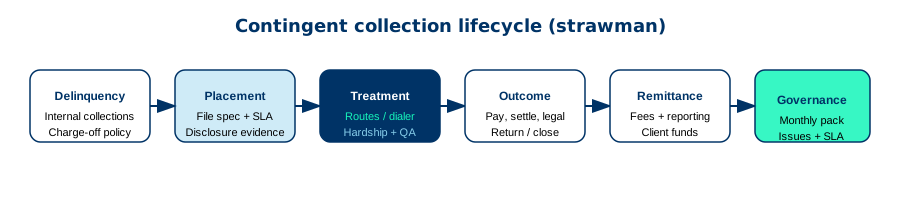
Think end to end: early delinquency, intensive internal work, specialist treatments, recoveries decision, then possibly internal recoveries warehouse, contingent DCA, second placement, debt sale, or terminal abandon or forgiveness. DCA is one tactic inside that arc, not the definition of recoveries. The Recoveries decision page holds the master strategic picture.
Common misunderstandings
- “DCA means written-off.” False as a rule. Many programmes place pre-charge-off debt with DCAs where policy allows.
- “Charge-off ends collection.” Often false operationally; accounting and customer obligation are different questions (see Source of Record).
- “The DCA system is the balance of record because they see the customer.” Dangerous. CP must control authoritative balance and payments.
- “R2 is just a rerun.” Usually false. Second placement should be a new strategy episode with traceability, not a blind recycle.
Lifecycle
Ecosystem
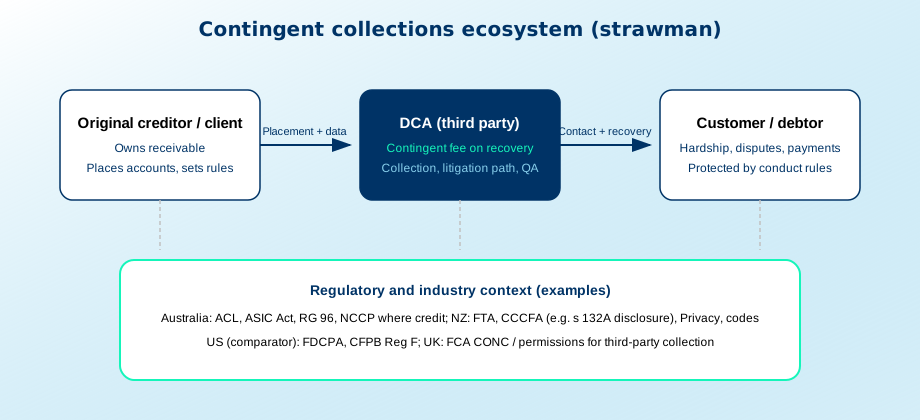
Australia and New Zealand (orientation)
- Australia: ASIC and ACCC publish joint RG 96 debt collection guidance. Consumer credit licensing and NCCP may apply.
- New Zealand: Fair Trading Act and CCCFA (including disclosure before debt collection where relevant) shape timing, content, and conduct. Confirm with your compliance team.
Questions to confirm in your organisation
- Consumer debt, commercial debt, or both?
- White-label (creditor brand only) vs DCA brand?
- Legal actions: in-house at DCA, panel firms, or creditor-led?
Next: Recoveries decision (master flow) · Requirements · Programme lifecycle (strategy through exit).